International Custody










International Custody Attorneys in Lewisville
The intricacies of custody law can be tough waters to navigate, all on their own. But when the bow of the family ship starts tilting unexpectedly towards international shores, this can raise a lot of serious questions about how other countries interact with custody laws in the United States.
Whether you are a blended family, or have become involved with other countries through work and career opportunities, the first thing to know is that you’re not alone. As the world becomes smaller, many families have found themselves in similar situations, and there are well-established guidelines to aid in whatever international custody problems you are facing.
To start untangling the knots in these complex issues, here is a little bit about how federal courts handle international custody, and what the team at North Texas Family Lawyers can do to help you.
INTERNATIONAL CUSTODY: THE BASICS
International custody is a subset of family law, which handles problems that arise when the parental powers granted by U.S. courts come at odds with institutions and laws in other countries. These issues often arise when a U.S. citizen and non-resident marry, have a child together, then later divorce, giving rise to a myriad of questions about custody, and jurisdiction.
Some of the most common of these scenarios occur when:
- The foreign parent refuses to return the child, after visiting another country;
- The U.S. parent refuses to allow the child to visit their parent, who is living in another country;
- Either parent unknowingly breaks the other country’s custody laws;
- One parent relocates with the child to another country, without getting the other parent’s permission first;
- The child wishes to remain in another country with their parent (rather than return to the United States); or,
- When both spouses move to another country for work, get divorced before returning to the U.S., and afterwards, one spouse wishes to remain in that country with the child.
Individual states do not have the power to negotiate with foreign entities on their own. Hence, when it comes to international custody, Texas courts are obligated to follow both federal law, as well as any international treaties the U.S. has entered into with other countries.
U.S. RESPONSE TO INTERNATIONAL CUSTODY
Over the decades, the United States has responded to the growing number of international custody related issues by passing various acts meant to unify the states and standardize procedures.
Some of these important laws include:
- The Uniform Child Custody Jurisdiction Enforcement Act;
- The International Parental Kidnapping Crime Act; and,
- The International Child Abduction Remedies Act.
Uniform Child Custody Jurisdiction Enforcement Act
Passed by Congress in 1997, the Uniform Child Custody Jurisdiction Enforcement Act (or, “UCCJEA”) helps determine which state has jurisdiction over custody disputes when the parents are from different states.
On an international level, the UCCJEA also requires state courts to uphold parenting plans made in a foreign country, including custody, visitation, and orders of child support (with limited exceptions).
International Parental Kidnapping Crime Act
In the United States, parent kidnappings are responsible for over ninety percent of child abductions. This is a common concern for divorcing couples, especially during the early stages of separation and divorce, before the court has time to deliver an official order. These concerns are only amplified if one spouse has a home in another country.
To lessen the frequency of international flight risks in these situations, the International Parental Kidnapping Crime Act was ratified in 1993. This made it a federal crime for a parent to remove—or even attempt to remove—their child to another country, in order to thwart the custodial rights of the child’s other parent.
International Child Abduction Remedies Act
Finally, in response to international efforts made at the Hague Convention in 1980, the United States passed the International Child Abduction Remedies Act. This law made the terms of the Hague Convention’s treaty legally enforceable, and required states to abide by its terms.
THE HAGUE CONVENTION
In the global arena, no treaty has made more of an effort to address international custody issues than the Hague Convention.
Drafted in the Netherlands in 1980, this pact attempts to create a unified, worldwide response to international custody disputes, and specifically addresses situations where a child has either been:
- Abducted from their home country by a parent; or,
- Wrongfully detained by their parent in a country that is not the child’s home country.
Today, nearly one hundred countries have signed the treaty, and while those numbers are certainly promising, they probably haven’t resulted in as much change as the original signers likely hoped. Mostly due to the fact that in this case, ratification doesn’t necessarily mean compliance.
The Hague Convention: Pitfalls
One of the biggest problems with trying to enforce the Hague Convention treaty is with jurisdiction—or, more specifically, persuading other countries to uphold orders handed down by a foreign court.
Unfortunately, many countries are reluctant to recognize outside authority. Entrenched in differing political structures, patriarchal customs, religious beliefs, and extreme national loyalty, it can sometimes be incredibly difficult to secure the cooperation of foreign governments in these matters—even from the ones who have signed the treaty.
This problem is exacerbated by the fact that the Hague Convention—for all its good intent—lacks any real teeth. Without a substantial way to enforce consequences, any country can simply revise, invalidate, or completely overturn custody arrangements made in another country.
WHAT TO DO IN AN INTERNATIONAL PARENTAL KIDNAPPING SITUATION
If your child has been abducted into another country by the child’s other parent, here’s what you should do:
- Act Fast—just like with stranger abductions, time is of the essence in parent abductions. If you think your ex may have unlawfully taken your child to another country, notify the authorities and your attorney immediately.
- Contact Your Attorney—international custody cases should not be handled on your own. It is essential to have an experienced, international family law attorney help you navigate these complex issues.
- File a Case—Your attorney will help you file a case with the U.S. State Department, requesting your child be returned under the terms of the Hague Convention.
- Find Foreign Counsel—In some situations it may be necessary to hire counsel in the country where your child was abducted to; if this is the case, your attorney can help you find a reputable, international custody attorney in that country.
- Do Your Research—Understand the terms of the Hague Convention, and how the country in question typically handles these types of disputes. This will help you keep pace with case updates, and help you better understand the nuances involved.
- Keep in Contact—When possible, keep in contact with your child. While children are not usually in danger from their other parent, it’s important to keep your connection to them intact. This helps them feel less abandoned, and strengthens their emotional ties to the U.S.
- Consider Relocating—Depending on the country, international custody disputes can take a long time to resolve. If circumstances permit, it’s not always a bad idea to relocate to that country, in order to be closer to your child.
Our Attorneys

William F. Neal
Texas Board Certified Family Law Attorney- More than 50 years of legal experience in Texas
- Texas Board Certified in Family Law since 1993
- Widely recognized for his professional excellence, unwavering dedication to his clients, and leadership in the field

James A. Giries
Family Law Attorney- Air Force veteran with a disciplined, honorable, and service-driven approach
- Former owner of an independent law practice for over a decade
- Significant experience and deep knowledge in divorce, custody, property division, and support matters

Trenton E. Wright
Family Law, Estate & Probate Attorney- Solving clients’ family law and estate issues with decades of advanced legal knowledge and experience
- Behind-the-scenes knowledge as a former owner of a real estate and title practice
- Serious background in property, business, and financial matters
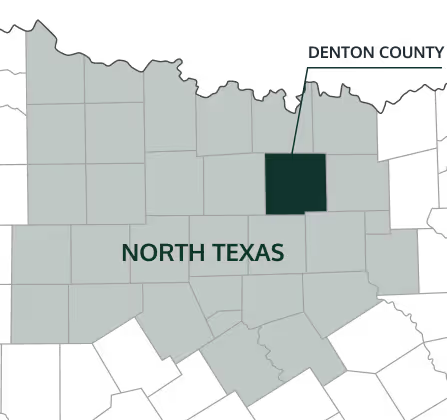
Serving Denton County And Beyond

Suite 150 Lewisville, TX 75067

North Texas Family Lawyers represents clients throughout Denton County and the surrounding communities from our Lewisville office. Our firm serves individuals and families who need trusted guidance, responsive communication, and experienced representation in high-net-worth divorce matters.
- Flower Mound
- Highland Village
- Westlake
- Bartonville
- Trophy Club
- Denton
- Lewisville
- The Colony
- Corinth
- Shady Shores
- Little Elm
- Carrolton
- Grapevine
- Argyle
- Frisco
- Fort Worth
North Texas Family Lawyers provides strategic advocacy for clients throughout Denton County and the surrounding communities. Whether you are local or in the wider region, our team ensures you move forward with confidence and a clear plan. We serve:
INTERNATIONAL CUSTODY ATTORNEYS IN TEXAS
In short, nothing is certain when dealing with international custody, and for that reason, alone, it is absolutely essential to have a family law attorney by your side—one you trust to fight for your child, and who is experienced in dealing with these complex, global issues.
The attorneys at North Texas Family Lawyers have the skill, expertise, and drive to do just that. If you have questions about international custody and how these laws might affect your situation, we hope you’ll trust us with these important concerns. Call us today at (972) 436-8000, or schedule a consultation online, and together, we can work to bring your child home again.