Lewisville Postnuptial Agreement Lawyer










Experienced Family Lawyers in Denton County, TX
For decades, North Texas Family Lawyers has stood beside individuals and families across Denton County facing high-stakes divorce, custody disputes, modifications, and complex probate battles.
At North Texas Family Lawyers, our postnuptial agreement attorneys in Lewisville provide tailored legal services to help couples navigate the complexities of their marital agreements. A postnuptial agreement is a valuable tool to address financial arrangements and clarify expectations, helping to strengthen the marital relationship through clear communication and mutual agreement.
Understanding Postnuptial Agreements & How They Work in Lewisville
Postnuptial agreements typically include provisions about property division, debt allocation, and financial responsibilities. In Texas, postnuptial agreements are valid so long as they are entered into voluntarily and with full disclosure from both parties. At North Texas Family Lawyers, we ensure that these agreements meet all legal requirements and provide peace of mind for both partners.
Given that Texas is a community property state, clear documentation distinguishing individual from shared assets is crucial to avoid disputes during enforcement proceedings. Couples often choose a postnuptial agreement as a proactive step to adapt to significant life changes, such as receiving an inheritance or navigating business transitions.
Key Benefits of Postnuptial Agreements
- Customized financial planning: Define personalized financial strategies and allocations according to your family’s specific needs.
- Reduced conflict: Ensure clarity on financial arrangements, reducing potential for future disputes.
- Asset protection: Secure personal or inherited assets, providing a safety net in case of marital discord.
Beyond financial security and conflict avoidance, postnuptial agreements also foster trust and transparency within a marriage. By engaging in open discussions facilitated by our seasoned legal team, couples can address potential areas of concern proactively. A well-crafted postnuptial agreement can function as a framework for resolving issues amicably, enhancing the mutual respect and understanding that underpin a healthy partnership.
Meet Our Attorneys

William F. Neal
Texas Board Certified Family Law Attorney- More than 50 years of legal experience in Texas
- Texas Board Certified in Family Law since 1993
- Widely recognized for his professional excellence, unwavering dedication to his clients, and leadership in the field

James A. Giries
Family Law Attorney- Air Force veteran with a disciplined, honorable, and service-driven approach
- Former owner of an independent law practice for over a decade
- Significant experience and deep knowledge in divorce, custody, property division, and support matters

Trenton E. Wright
Family Law, Estate & Probate Attorney- Solving clients’ family law and estate issues with decades of advanced legal knowledge and experience
- Behind-the-scenes knowledge as a former owner of a real estate and title practice
- Serious background in property, business, and financial matters
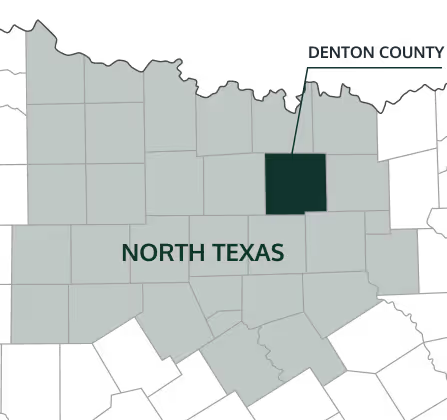
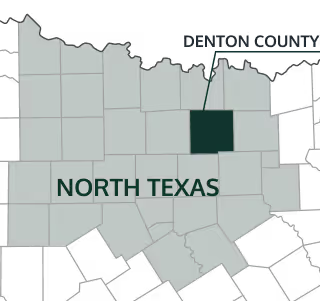
Serving Across Denton County
Suite 150 Lewisville, TX 75067

North Texas Family Lawyers provides strategic advocacy for clients throughout Denton County and the surrounding communities. Whether you are local or in the wider region, our team ensures you move forward with confidence and a clear plan. We serve:
- Flower Mound
- Highland Village
- Westlake
- Bartonville
- Trophy Club
- Denton
- Lewisville
- The Colony
- Corinth
- Shady Shores
- Little Elm
- Carrolton
- Grapevine
- Argyle
- Frisco
- Fort Worth
Contact Our Postnuptial Agreement Lawyers in Lewisville
Reach out to North Texas Family Lawyers to discuss your needs with one of our experienced postnuptial agreement attorneys. Our commitment to personalized, compassionate service ensures you receive the guidance needed to protect your interests. Whether you're updating an existing agreement or starting anew, our tailored approach ensures that your legal journey is as smooth and effective as possible.
FAQs
A comprehensive postnuptial agreement should clearly outline asset distribution, clarify debts, and establish financial responsibilities. It may also cover spousal support terms. Incorporating clauses for dispute resolution, including mediatory steps, can provide valuable conflict resolution mechanisms. This foresight ensures that couples have predetermined pathways for addressing disagreements arising from the agreement, minimizing litigation risks. Additionally, safeguarding future inheritances or planned educational expenses for children can be highly beneficial if explicitly detailed. Our team ensures that these considerations align with Texas statutes and offer longevity to the agreement’s relevance.
Under Texas law, postnuptial agreements must be entered voluntarily and include full disclosure from both parties. Agreeing under duress or without complete information can lead to unenforceability. Texas courts especially emphasize transparency and fairness. This means that any signs of coercion or fraud can render an agreement suspect under judicial review.
Without a postnuptial agreement, asset division and financial responsibilities may be governed by default state laws in the event of a dispute or divorce, which might not align with your personal preferences. Securing a postnuptial agreement allows you to take control over these decisions.
Lack of a postnuptial agreement often leads to uncertainty and emotional turmoil during marital separation or divorce, as default legal frameworks might allocate property and debts contrary to your wishes. This means individuals may face outcomes that do not reflect their contributions or future needs. By preemptively setting terms tailored to personal circumstances, couples maintain autonomy over their marital and financial futures.
Yes, postnuptial agreements can be modified with the consent of both parties. As family circumstances evolve, amendments may be necessary. When life changes, such as the birth of children or significant shifts in financial status, occur, revisiting your postnuptial agreement becomes crucial.