Denton County Spousal Maintenance Lawyers










Experienced Alimony Lawyers in Denton County, TX
Spousal maintenance can become one of the most important financial issues in a divorce, especially when one spouse will leave the marriage at a clear economic disadvantage. At North Texas Family Lawyers, we represent clients across Denton County in spousal maintenance matters involving eligibility, amount, duration, negotiation, and contested support requests.
Whether you are seeking maintenance or defending against an unreasonable demand, our team provides the experienced guidance and strategic representation needed to protect your financial future.
- Extensive Divorce Experience We bring more than 50 years of legal expertise to divorce matters involving support, property, custody, and other financial issues.
- Prepared for Disputed Support Issues When spouses disagree over need, ability to pay, or how long support should last, we are ready to advocate for our clients in negotiation or in court.
- Straightforward Client Guidance We give clients practical advice, clear expectations, and responsive communication throughout the process.
Understanding Spousal Maintenance in Texas
Spousal maintenance, sometimes called spousal support or alimony, is money one spouse may be ordered to pay the other after divorce. In Texas, it is not automatically awarded simply because one spouse earns more. Instead, courts may order maintenance only when statutory requirements are met, and the requesting spouse lacks sufficient property to provide for minimum reasonable needs.
Even when maintenance is on the table, the court must still look closely at the facts of the case. Questions about length of the marriage, earning ability, health, disability, child-related responsibilities, and financial need can all affect whether maintenance is available and, if so, what it may look like. Texas law also limits the duration of maintenance based on the qualifying basis and the length of the marriage.
Common Spousal Maintenance Issues
#faq_start
Seeking Spousal Maintenance
Some divorcing spouses may need post-divorce financial support to meet basic needs, especially after a long marriage or when one spouse has been financially dependent. We help clients assess whether a maintenance request is likely to be viable under Texas law.
Defending Against a Maintenance Request
Not every maintenance request is legally justified. We represent clients responding to support demands involving disputed need, disputed eligibility, or disagreements over amount and duration.
Maintenance Amount and Duration Disputes
Even when maintenance may be available, the parties often disagree about how much to pay and for how long. We help clients evaluate the relevant factors and advocate for outcomes grounded in the facts of the case.
Support Issues Involving Disability or Caregiving Responsibilities
Maintenance questions can become more involved when a spouse has a disability or is responsible for a child with a physical or mental disability that affects the ability to work. We help clients address these circumstances with careful legal analysis.
Agreed Support vs. Court-Ordered Maintenance
Some spouses reach their own agreement on support as part of the divorce settlement, while others leave the issue to the court. We help clients evaluate both options and pursue the approach that best fits their goals and circumstances.
#faq_end
Who May Qualify for Spousal Support in Texas
Texas law generally requires the spouse seeking maintenance to show that they cannot meet minimum reasonable needs with available property. In addition, at least one recognized statutory basis must apply, such as a recent family violence conviction, a physical or mental disability, a long-term marriage, or the need to care for a child of the marriage who has a disability that requires substantial care.
Length of the Marriage
One of the most commonly discussed paths to maintenance involves marriages lasting at least 10 years. Even then, maintenance is not automatic. The requesting spouse must still show an inability to meet minimum reasonable needs and satisfy the court that support is appropriate under the circumstances.
Disability and Caregiving Issues
Maintenance may also be available when a spouse has a mental or physical disability that limits earning ability, or when the spouse is caring for a child of the marriage whose condition requires substantial supervision and prevents the spouse from earning sufficient income. These situations often require a closer look at the family’s day-to-day realities and long-term financial needs.
Family Violence
Texas law also allows maintenance in certain cases involving family violence. When that issue is part of the divorce, it can affect eligibility and the overall strategy of the case.
What Courts Consider When Setting Maintenance

If maintenance is at issue, the court may evaluate a range of factors beyond basic eligibility. These can include the length of the marriage, each spouse’s age and health, earning ability, education and job skills, contributions as a homemaker, child-related responsibilities, and whether one spouse contributed to the other’s education or career.
Courts may also consider fraud involving community property and, in some cases, marital fault. The old page specifically notes adultery, cruelty, neglect, impotence, and insanity as fault-based grounds that may matter in divorce strategy.
Because these issues are highly fact-specific, the same label — “spousal maintenance” — can look very different from one case to the next. A strong presentation of the facts can make a meaningful difference in how the issue is resolved.
#cta_start
Support Disputes Can Shape Your Financial Future
Spousal maintenance can affect your finances long after the divorce is finalized, whether you are requesting support or being asked to pay it. Schedule a confidential consultation to discuss your situation and get experienced guidance from our top family law specialists on how Texas law may apply to your case.
#cta_end
Spousal Maintenance Process in Denton County, TX
Support disputes often develop alongside larger divorce issues involving property, custody, and future financial planning. At North Texas Family Lawyers, we help clients address maintenance questions with a clear strategy and close attention to the facts that may affect the outcome.
- Initial Consultation
We begin with a confidential consultation to understand your financial situation, the marriage history, and the support concerns involved. - Case Evaluation and Strategy
Our team reviews eligibility, need, earning capacity, and the surrounding divorce issues to determine the strongest path forward. - Filing or Responding
Depending on your position, we help pursue or respond to spousal maintenance claims within the divorce case. - Information Gathering
We work with clients to collect financial records, employment information, medical documentation, and other evidence relevant to maintenance. - Negotiation and Resolution Efforts
When appropriate, we pursue agreed support terms through negotiation or mediation. - Court Representation When Needed
If the issue cannot be resolved by agreement, we are prepared to present the support case to the court. - Final Orders and Next Steps
Once maintenance is resolved, we help ensure the final order clearly addresses amount, duration, and any related obligations.
Meet Our Attorneys

William F. Neal
Texas Board Certified Family Law Attorney- More than 50 years of legal experience in Texas
- Texas Board Certified in Family Law since 1993
- Widely recognized for his professional excellence, unwavering dedication to his clients, and leadership in the field

James A. Giries
Family Law Attorney- Air Force veteran with a disciplined, honorable, and service-driven approach
- Former owner of an independent law practice for over a decade
- Significant experience and deep knowledge in divorce, custody, property division, and support matters

Trenton E. Wright
Family Law, Estate & Probate Attorney- Solving clients’ family law and estate issues with decades of advanced legal knowledge and experience
- Behind-the-scenes knowledge as a former owner of a real estate and title practice
- Serious background in property, business, and financial matters
Serving Denton County and Beyond
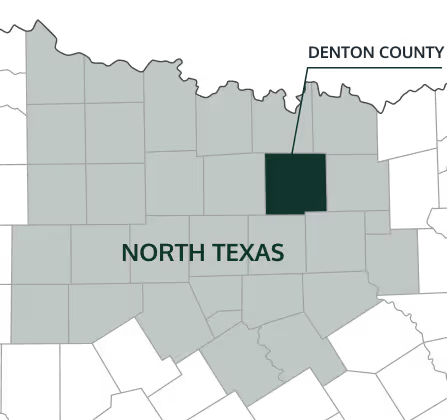
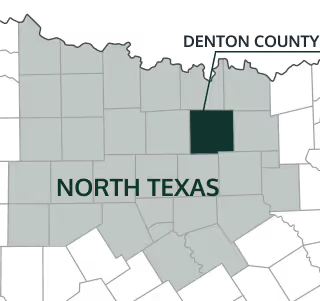
Suite 150 Lewisville, TX 75067

North Texas Family Lawyers represents clients throughout Denton County and the surrounding communities from our office in Lewisville. Our firm serves individuals and families who need experienced, responsive legal counsel in divorce matters involving spousal maintenance and related financial issues.
- Flower Mound
- Highland Village
- Westlake
- Bartonville
- Trophy Club
- Denton
- Lewisville
- The Colony
- Corinth
- Shady Shores
- Little Elm
- Carrolton
- Grapevine
- Argyle
- Frisco
- Fort Worth
Whether you are trying to understand whether maintenance may apply or responding to a support dispute that has already developed, we are proud to serve clients across Denton County with practical, strategic counsel.
Talk to a Denton County Spousal Support Lawyer
Whether you are seeking spousal maintenance or responding to a support request, the outcome can affect your financial stability long after the divorce is final. Complete this form to request your confidential consultation and start building a plan with our elite Denton County divorce lawyers who are always prepared to protect your interests.
FAQs
No. Texas courts do not automatically award spousal maintenance. A spouse seeking maintenance must meet statutory eligibility requirements and show insufficient property to meet minimum reasonable needs.
Texas law caps court-ordered maintenance at the lesser of $5,000 per month or 20% of the paying spouse’s average monthly gross income.
No. A marriage lasting at least 10 years may satisfy part of the eligibility analysis, but maintenance is still not guaranteed. The spouse requesting support must still show an inability to meet minimum reasonable needs and satisfy the other legal requirements.
Yes. These are separate issues that may both be part of the same divorce case, depending on the facts. Child-related needs may also affect the broader financial picture the court is considering.
Duration depends on the legal basis for maintenance and the length of the marriage. Texas law places limits on how long maintenance may remain in effect, with longer possible durations in certain disability-related situations.