Denton County Property Division Lawyers










Experienced Property Division Lawyers in Denton County, TX
At North Texas Family Lawyers, we help individuals and families across Denton County protect what they've built when a marriage ends. From the family home to retirement accounts, business interests, and mineral rights, property division shapes your financial future long after the divorce is final.
- Extensive Experience We bring more than 75 years of legal experience to property division matters involving families across Denton County.
- Trial-Ready When negotiations cannot resolve a dispute over property or debt, we are prepared to advocate for our clients in court.
- Genuine Client Care We provide clear advice, responsive communication, and steady support throughout the process.
How Is Property Division Handled in Texas?
Texas is a community property state, meaning that most property acquired during the marriage is presumed to belong to both spouses, regardless of whose name is on the title or account. Property owned before the marriage, along with certain inheritances and gifts received during the marriage, is generally treated as separate property and is not subject to division.
That distinction sounds simple, but in practice, it is rarely straightforward. Accounts get commingled, values change over time, and documentation is not always easy to track down years into a marriage. Understanding how your specific assets are likely to be classified is often the first step toward a fair outcome.

Community Property vs. Separate Property
Community property generally includes income earned during the marriage, along with anything purchased with that income, such as homes, vehicles, and investment accounts.
Separate property typically includes assets owned before the marriage, inheritances, and gifts given specifically to one spouse. When separate property has been mixed with community funds over the years, tracing its origin can become a central issue in the case.
How Texas Courts Divide Marital Property
Texas law requires that community property be divided in a manner the court considers "just and right", which does not always mean an equal 50/50 split. Judges may consider factors such as each spouse's earning capacity, the size of each spouse's separate estate, fault in the breakup of the marriage, and the needs of any children when deciding how to divide the marital estate.
Common Assets Involved in Property Division
Every marriage looks different, and so does every marital estate. We regularly help clients identify, value, and divide:
- The family home and other real estate;
- Family-owned businesses and professional practices;
- Retirement accounts, pensions, and 401(k)s;
- Investment accounts, stocks, and bonds;
- Trusts and inheritances;
- Mineral rights and drilling rights;
- Marital debt and liabilities;
- Property that may have been hidden or undisclosed.

Who Gets the House in a Divorce?
The family home is often the most emotionally significant asset in a divorce, and there is no automatic rule about who keeps it. Courts consider factors such as which spouse will have primary time with the children, each spouse's ability to afford the home going forward, and whether the property is community or separate in nature.
In many cases, couples agree to sell the home and split the proceeds, or one spouse buys out the other's share of the equity.
Business Ownership and Property Division
When a family-owned business or professional practice is part of the marital estate, property division becomes significantly more involved. Questions about how the business was valued, whether it was started before or during the marriage, and how much community effort went into its growth can all affect the outcome.
Retirement Accounts and QDROs
Dividing a 401(k), pension, or other retirement account often requires a Qualified Domestic Relations Order (QDRO), a separate court order that directs the plan administrator on how to divide the account. These orders must be drafted carefully to avoid unnecessary tax penalties or delays.
Hidden Assets and Financial Disclosure
In some divorces, one spouse attempts to conceal assets, undervalue a business, or delay disclosing financial records. We work to uncover the full picture of the marital estate through formal discovery so that property division is based on accurate and complete information.
#cta_start
Protect What You've Built
Property division decisions can affect your financial stability for years to come. Schedule a confidential consultation to discuss your assets, your concerns, and how Texas law applies to your specific situation.
#cta_end
Steps to Protect Your Property During Divorce
- Gather your financial records early: Bank statements, tax returns, deeds, and account statements are all useful when identifying and valuing the marital estate.
- Document separate property: If you owned an asset before the marriage or received it as a gift or inheritance, keep records that show its origin and history.
- Avoid major financial moves: Large purchases, transfers, or account changes made without legal guidance can complicate your case or raise questions in court.
- Be transparent about assets and debts: Texas law requires full disclosure, and attempting to hide property can hurt your credibility with the court.
- Talk to an attorney before agreeing to anything: A settlement that looks reasonable on paper may not account for tax consequences, future value, or hidden liabilities.
Mineral Rights and Other Complex Denton County Assets
Denton County sits within an active oil and gas region, and mineral rights, royalty interests, and drilling leases can be part of a family's marital estate without either spouse fully realizing their value. These interests require careful identification and valuation, just like any other community asset, and are easy to overlook without experienced legal guidance.
The Property Division Process in Denton County, TX

At North Texas Family Lawyers, we help clients move through property division with a clear strategy and close attention to detail.
- Initial Consultation
We begin with a confidential consultation to understand your assets, debts, and the concerns most important to you. - Case Evaluation and Strategy
Our team reviews the marital estate to identify community and separate property and to flag issues that may require closer attention. - Information Gathering
We work with you to collect financial records, account statements, appraisals, and other documentation needed to support your position. - Valuation of Assets
When needed, we work with financial professionals to properly value businesses, real estate, and other complex assets. - Negotiation and Resolution Efforts
We pursue a fair division of property through negotiation, mediation, or other settlement efforts whenever possible. - Court Representation When Needed
If an agreement cannot be reached, we are prepared to advocate for your interests in court. - Finalizing the Division
Once property division terms are resolved, we help ensure they are reflected in your final decree, including any required QDROs or transfer documents.
Meet Our Attorneys

William F. Neal
Texas Board Certified Family Law Attorney- More than 50 years of legal experience in Texas
- Texas Board Certified in Family Law since 1993
- Widely recognized for his professional excellence, unwavering dedication to his clients, and leadership in the field

James A. Giries
Family Law Attorney- Air Force veteran with a disciplined, honorable, and service-driven approach
- Former owner of an independent law practice for over a decade
- Significant experience and deep knowledge in divorce, custody, property division, and support matters

Trenton E. Wright
Family Law, Estate & Probate Attorney- Solving clients’ family law and estate issues with decades of advanced legal knowledge and experience
- Behind-the-scenes knowledge as a former owner of a real estate and title practice
- Serious background in property, business, and financial matters
Serving Denton County and Beyond
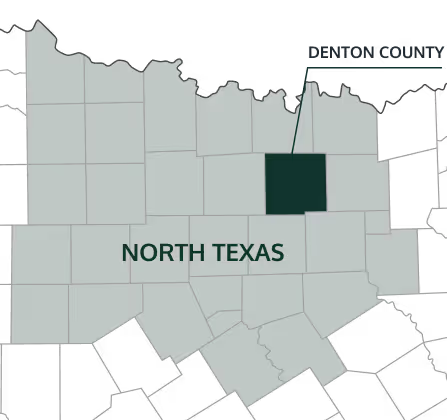
Suite 150 Lewisville, TX 75067

North Texas Family Lawyers represents clients throughout Denton County and the surrounding communities from our office in Lewisville. Our firm serves individuals and families who need trusted guidance, responsive communication, and experienced representation in property division matters.
- Flower Mound
- Highland Village
- Westlake
- Bartonville
- Trophy Club
- Denton
- Lewisville
- The Colony
- Corinth
- Shady Shores
- Little Elm
- Carrollton
- Grapevine
- Argyle
- Frisco
- Fort Worth
Whether your case involves a modest estate or complex, high-value assets, we are proud to serve clients across Denton County with practical, strategic counsel.
Talk to a Denton County Property Division Lawyer
Property division can shape your finances long after the divorce is final. Complete this form to request your confidential consultation and speak with an experienced property division lawyer about your situation.
FAQs
Not exactly. Texas is a community property state, but the law requires a division that is "just and right," which does not always mean an equal split. Courts may consider each spouse's earning capacity, the size of their separate estate, and other factors when dividing community property.
Separate property generally includes assets owned before the marriage, along with inheritances and gifts given specifically to one spouse during the marriage. Separate property is not divided in a divorce, but it must be clearly identified and documented.
A business may be subject to division if it was started or grew in value during the marriage, or if community funds or effort contributed to its success. These cases often require a professional valuation and careful legal analysis.
Retirement accounts earned during the marriage are typically considered community property. Dividing them usually requires a Qualified Domestic Relations Order (QDRO), a separate legal document that instructs the plan administrator on how to split the account.
If you suspect your spouse is concealing property or income, your attorney can use formal discovery tools to uncover financial records, business documents, and other evidence. Texas law requires full financial disclosure during divorce proceedings.
You are not required to hire a lawyer, but property division can have long-term financial consequences, especially when a home, business, retirement accounts, or mineral rights are involved. Experienced legal guidance can help you understand your rights and avoid costly mistakes.