Denton County Parental Rights Lawyers










Experienced Parental Rights Lawyers in Denton County, TX
At North Texas Family Lawyers, we help parents across Denton County protect their rights to make decisions for their children and remain an active, involved presence in their lives. Whether you are going through a divorce, addressing paternity, or responding to a dispute with the other parent, our team helps you understand what the law allows and how to protect your role as a parent.
- Extensive ExperienceWe bring more than 50 years of legal experience to parental rights matters involving families across Denton County.
- Trial-ReadyWhen disputes over parental rights cannot be resolved through agreement, we are prepared to advocate for our clients in court.
- Genuine Client CareWe provide clear advice, responsive communication, and steady support throughout the process.
Understanding Parental Rights in Texas
Parental rights do not end simply because a marriage does. In Texas, parents retain broad authority to raise their children and make decisions for them even after a divorce, separation, or paternity case, though that authority is often divided between both parents once a case is filed.
When parents cannot resolve these issues and reach an agreement on their own, a court will decide how parental rights and duties are allocated between them, guided by what is in the best interest of the child. Understanding the terminology and the framework Texas courts use is often the first step toward protecting your position.
#faq_start
Conservatorship, Possession, and Access
Texas law does not use the term "custody" in the way many other states do. Instead, the Texas Family Code refers to conservatorship, which addresses a parent's rights and duties, and possession and access, which address the time a parent spends with the child.
Courts generally favor joint managing conservatorship, meaning both parents share decision-making, unless there is a reason, such as family violence or abuse, that makes joint conservatorship inappropriate for the child.
The Right to Make Decisions for Your Child
Texas law treats certain decisions about a child's upbringing as fundamental parental rights. These often include decisions about the child's education, medical and dental treatment, psychological or psychiatric care, and religious upbringing. Depending on the case, these rights may be shared jointly, divided between parents, or in some cases awarded independently to one parent.
The Right to Possession and Access to Your Child
Parents also have a right to physical time with their child, generally referred to as possession and access. Texas courts strongly favor arrangements that give both parents meaningful time with their children and will typically limit a parent's access only when evidence shows it is necessary to protect the child.
#faq_end
Other Parental Rights Recognized Under Texas Law
Beyond decision-making and possession, Texas parents are entitled to a number of additional rights that are often addressed in a parenting plan, including the right to:
- Receive information about the child's health, education, and welfare directly from the other parent;
- Access the child's medical, dental, psychological, and school records;
- Attend the child's school activities and extracurricular events;
- Be listed as an emergency contact for the child;
- Consult with the child's physicians, teachers, and other professionals;
- Manage the child's estate, if applicable.
These rights are typically set out in a parenting plan and become enforceable once incorporated into a final court order.
#cta_start
Protect Your Role as a Parent
Whether you are facing divorce, a paternity matter, or a dispute over decision-making, understanding and protecting your parental rights is essential. Schedule a consultation to discuss your situation.
#cta_end
When Parental Rights Disputes Arise
Divorce and Separation
When married parents divorce, parental rights and duties must be formally divided, either through an agreed parenting plan or, if the parents cannot agree, through a court order following litigation.
Unmarried Parents and Paternity
For unmarried parents, a father's legal parental rights are generally not recognized until paternity is established, either through a voluntary Acknowledgment of Paternity or a court order. Establishing paternity is often a necessary first step before a father can seek conservatorship, possession, or access.
Disputes Between Parents
Even after an order is in place, disagreements can arise over how decisions are being made, whether one parent is being excluded from important information, or whether agreed possession terms are being followed. These disputes may require modification or enforcement action.
Grandparents and Third-Party Rights
In limited circumstances, individuals other than a child's parents, such as grandparents, may be able to seek limited rights involving a child. These cases are highly fact-specific and require careful legal evaluation.
Protecting Your Parental Rights: What You Can Do

- Put agreements in writing. Informal understandings between parents can be difficult to enforce. A formal parenting plan incorporated into a court order provides clarity and legal protection.
- Keep records. Documenting communication, missed exchanges, or excluded decisions can help support your position if a dispute or enforcement action becomes necessary.
- Respond to violations promptly. Waiting too long to address a violation of your parental rights can make it harder to resolve later.
- Understand what the law allows. Parental rights can be nuanced, and knowing the difference between conservatorship, possession, and access helps you make informed decisions.
- Talk to an attorney early. Whether you are establishing rights for the first time or protecting rights you already have, early legal guidance can help you avoid costly missteps.
Parental Rights Process in Denton County, TX
At North Texas Family Lawyers, we help clients establish, protect, and enforce parental rights with a clear strategy tailored to each family's circumstances.
- Initial Consultation
We begin with a confidential consultation to understand your situation, your relationship with the other parent, and the outcome you are seeking. - Case Evaluation and Strategy
Our team reviews the facts, applicable law, and family dynamics involved to determine the strongest approach. - Filing or Responding
We help initiate or respond to legal action involving conservatorship, possession, access, paternity, or parental rights disputes. - Information Gathering
We work with you to collect communications, records, and other documentation that may support your case. - Negotiation and Resolution Efforts
When appropriate, we pursue agreements through negotiation or mediation that reflect your parental rights and your child's best interests. - Court Representation When Needed
If the matter cannot be resolved outside of court, we are prepared to advocate for your rights before the judge. - Final Orders and Ongoing Issues
Once the matter is resolved, we help ensure your parental rights are clearly reflected in the final order and remain available to assist with future enforcement or modification needs.
Meet Our Attorneys

William F. Neal
Texas Board Certified Family Law Attorney- More than 50 years of legal experience in Texas
- Texas Board Certified in Family Law since 1993
- Widely recognized for his professional excellence, unwavering dedication to his clients, and leadership in the field

James A. Giries
Family Law Attorney- Air Force veteran with a disciplined, honorable, and service-driven approach
- Former owner of an independent law practice for over a decade
- Significant experience and deep knowledge in divorce, custody, property division, and support matters

Trenton E. Wright
Family Law, Estate & Probate Attorney- Solving clients’ family law and estate issues with decades of advanced legal knowledge and experience
- Behind-the-scenes knowledge as a former owner of a real estate and title practice
- Serious background in property, business, and financial matters
Serving Denton County and Beyond
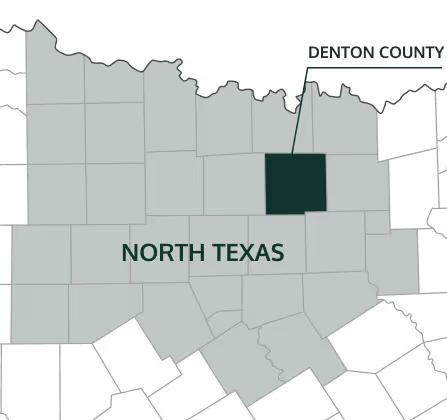
Suite 150 Lewisville, TX 75067

North Texas Family Lawyers represents parents throughout Denton County and the surrounding communities from our office in Lewisville. Our firm serves clients who need trusted guidance, responsive communication, and experienced representation in parental rights matters.
- Flower Mound
- Highland Village
- Westlake
- Bartonville
- Trophy Club
- Denton
- Lewisville
- The Colony
- Corinth
- Shady Shores
- Little Elm
- Carrolton
- Grapevine
- Argyle
- Frisco
- Fort Worth
Whether you are establishing your rights for the first time or addressing a dispute that has grown more difficult over time, we are proud to serve clients across Denton County with practical, strategic counsel.
Talk to a Denton County Parental Rights Lawyer
Questions about your parental rights can become urgent quickly, especially when your role in your child's life is being challenged. Complete the form below to request your confidential consultation and speak with an experienced parental rights lawyers about your situation.
FAQs
Parental rights refer to a parent's legal authority to make decisions for their child and to spend time with them. In Texas, these rights are typically addressed through conservatorship, possession, and access rather than the term "custody" used in some other states.
No. Parental rights do not end because of divorce. Instead, the rights and duties that come with parenting are divided between both parents through a parenting plan or court order.
An unmarried father's legal parental rights are generally not established until paternity is confirmed, either voluntarily or through a court order. Once paternity is established, a father may seek conservatorship, possession, and access like any other parent.
Conservatorship refers to a parent's legal rights and duties, including decision-making authority. Possession and access refer to the actual time a parent spends with the child. A parent can have rights in one area without having the exact same rights in the other, depending on the case.
In most cases, Texas courts strongly favor both parents remaining involved in a child's life. Parental rights may be limited or, in rare and serious circumstances, terminated, but only when there is significant evidence that doing so is necessary to protect the child.
If the other parent is violating your rights under a parenting plan or court order, such as withholding information or interfering with your possession time, you may be able to pursue enforcement through the court. Addressing violations early can help prevent the issue from growing more serious.